
PETG filament is primarily used for printing functional and durable parts like brackets, clips, enclosures, and mechanical components. Its unique balance of strength, flexibility, and ease of printing makes it a favorite for practical applications, from organizers to outdoor items. Makers clearly value this balance. PETG holds an estimated 10–15% of the consumer filament market, and annual consumption grows about 15–18% each year.
|
Filament Type |
Estimated Consumer Market Share |
|---|---|
|
PLA |
~70–75% |
|
PETG |
~10–15% |
|
ABS / ASA |
~8% |
You will learn the specific properties, settings, and limitations that make PETG a go-to material for everyday prints. You will also find insights from the EPELAY product line.
Key Takeaways
-
PETG filament is perfect for printing strong, durable parts like brackets, clips, and outdoor items.
-
PETG bends under stress instead of cracking, making it tougher than PLA for functional prints.
-
PETG needs specific slicer settings: nozzle 230–250°C, bed 80–90°C, and fan 30–50% after the first layers.
-
PETG resists water and chemicals better than PLA, but it can yellow in prolonged sunlight.
-
PETG offers a practical middle ground: easier to print than ABS and tougher than PLA, at a competitive price.
Top Applications for PETG Filament
Functional Parts
Functional parts form the heart of most PETG printing work. You will find this material in cable clips, drawer organizers, tool holders, brackets, mounts, clips, tabs, and parts that need to snap into position. Cable guides, SSD holders, Raspberry Pi cases, fan brackets, and small mounts also print well in PETG. Each of these parts shares one trait: it must survive real handling without cracking.
Snap-fit designs show off the material's ductility. Reusable enclosure latches, functional battery doors, tool latches, and reusable enclosure clips all benefit from PETG's higher flexibility than PLA. The material absorbs bending stress during repeated flexing. Keep an eye on long-term creep in parts that stay under constant load.
Gears and planters also suit this filament. PETG yields under stress instead of snapping, which helps gears that flex during assembly and absorb vibration. Its glass transition sits near 81°C, compared with roughly 61°C for PLA, so planters resist drooping in sun and heat. As one design guide puts it, "If you are designing a clamp, a gear, or a buckle, you need the material to flex. PETG's ductility prevents it from cracking under the strain of assembly."
Lighting projects deserve a mention too. Clear PETG transmits about 88% of light and offers high impact resistance. That makes it a strong alternative to acrylic for light covers in high-impact environments. Diffusers, LED strips, and sign panels all gain a durable, slightly frosted glow.
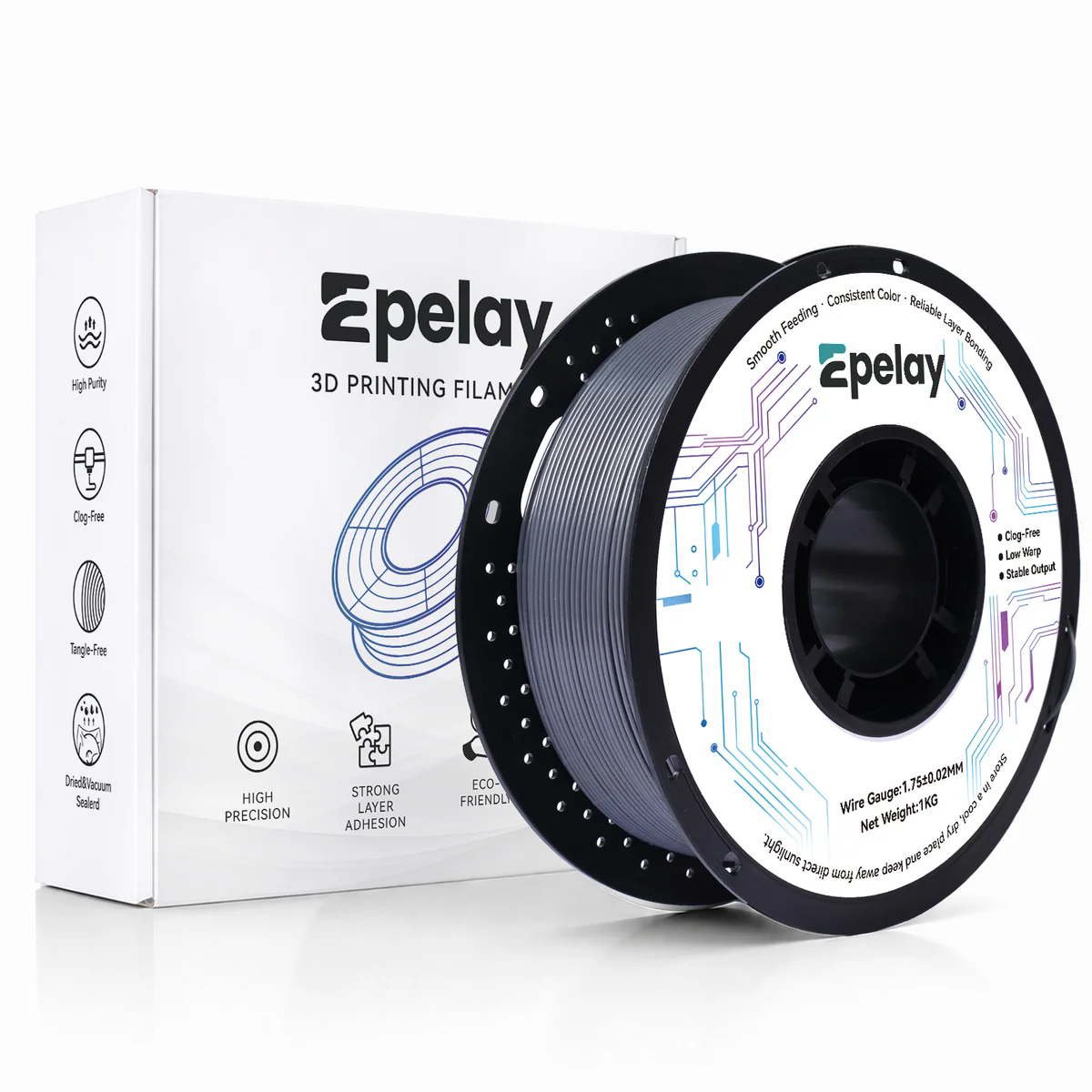
EPELAY PETG 3D Printer Filament 1.75mm, 1kg handles organizers, brackets, and fixtures with consistent feeding. The 1kg spool keeps longer projects running without a swap.
Outdoor and Everyday Items
Outdoor work is where petg filament earns its middle-ground reputation. It resists water better than PLA and handles short-to-medium outdoor jobs well. Good uses include watertight boxes and planters, wet garden tool holders, brackets for lights and signs, rain-resistant covers, and strong flexible clips.
The comparison below shows where PETG sits among common filaments.
|
Filament |
UV Resistance |
Outdoor Lifespan |
Approx. Tg (°C) |
Heat Resistance |
|---|---|---|---|---|
|
PLA |
Low |
Short |
~60 |
Low |
|
PETG |
Medium |
Moderate |
~80 |
Medium |
|
ASA |
High |
Long |
~105 |
High |
PETG outperforms ABS outdoors, yet it can yellow and lose strength under prolonged sun. For continuous sunlight and harsh weather, ASA remains the better pick, and EPELAY offers ASA for extended UV exposure. UV resistance also depends heavily on formulation, additives, and stabilizers, so check your spool's specs before committing a part to full-time sun.
Everyday items round out the list. Hooks, handles, phone stands, storage bins, and replacement knobs all benefit from a material that shrugs off drops and daily wear. You get a part that feels solid in the hand and holds its shape through warm afternoons.
Key Properties of PETG Filament
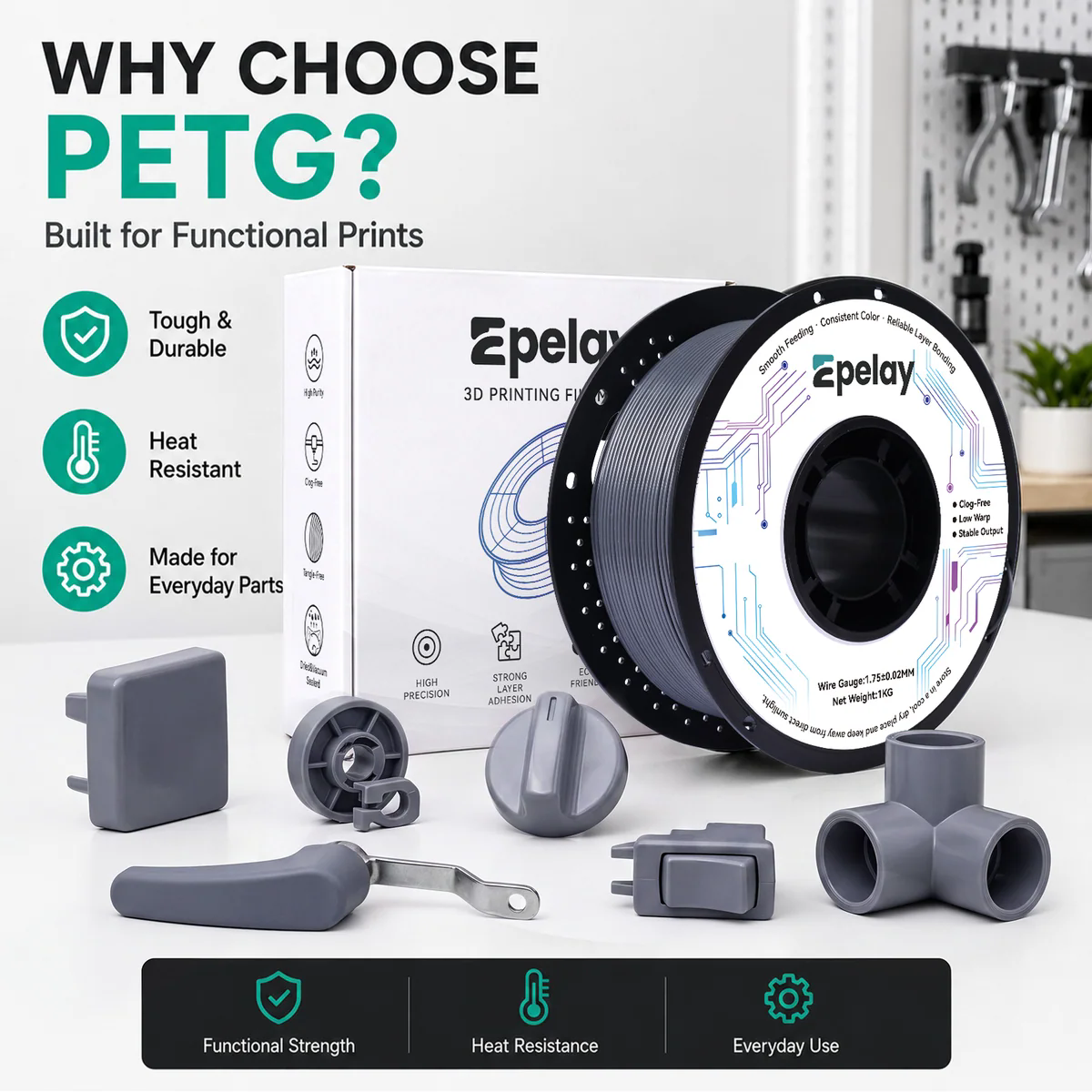
PETG earns its place in functional printing through a specific mix of mechanical and chemical traits. You can trace most of its behavior back to two things: how it stretches under load and how it reacts to the world around it.
Strength and Flexibility
PETG holds up well under stress. Published material data gives a tensile strength of 75 MPa at 23 ºC and 50 mm/min, tested to ISO 527-1/-2. Charpy notched impact strength exceeds 5 kJ/m² at 23 ºC under ISO 179/1eA, and unnotched impact strength exceeds 50 kJ/m² under ISO 179/1eU. Those numbers describe a material that absorbs shocks instead of shattering.
|
Property |
Condition |
Value |
Test Method |
|---|---|---|---|
|
Tensile Strength |
23 ºC, 50 mm/min |
75 MPa |
ISO 527-1/-2 |
|
Charpy Notched Impact Strength |
23 ºC |
> 5 kJ/m² |
ISO 179/1eA |
|
Unnotched Charpy Impact Strength |
23 ºC |
> 50 kJ/m² |
ISO 179/1eU |
Other sources place tensile strength in the 30.1–45.3 MPa and 45–55 MPa bands, with some PETG grades reaching 55–60 MPa against PLA. The spread reflects brand and print orientation. Treat any single figure as a guide, not a guarantee for your own print.
The flexibility story matters just as much. Elongation at break for PETG is reported in the range of 7.6–36%, a balance of stretch and impact resistance. Compared with PLA at 2–8% and ABS at 10–34%, PETG bends further before it fails. A clip printed in petg filament flexes during installation and springs back. The same clip in PLA may crack on the first snap. PETG also bonds layers better than ABS, so prints resist splitting along layer lines.
Failure mode separates the two materials clearly. PLA needs more force to break, then shatters into pieces. PETG deforms and yields before complete fracture, which is the safer outcome for a bracket or housing. A PLA bracket may hold a high static load and crack when dropped. A PETG bracket may flex and keep working. Compared with ABS, PETG's impact strength is moderate; ABS is superior on that single measure. PETG still wins on layer bonding and print reliability.
Glycol modification gives PETG better clarity, durability, and printability than plain PET. You get cleaner layers and a tougher finished part. Temperature capability also beats standard PLA. PETG's glass transition sits near 81°C, compared with roughly 61°C for PLA, so a part left in a warm car keeps its shape.
Chemical Resistance
PETG resists a wide range of solvents and weak acids. Diluted acids do not damage it. Oils, fats, and alcohols leave it unaffected, which makes it safe for kitchen tools, garage fixtures, and parts that touch cleaning agents at home or in the shop.
This resistance beats both PLA and ABS on most counts. PLA offers low chemical resistance overall. ABS resists oils, acids, and bases but stays sensitive to some solvents, and acetone can dissolve ABS prints outright. PETG tolerates alcohol and most household chemicals without breaking down. Weather resistance adds to the case. PETG handles moisture better than PLA, so outdoor parts survive damp conditions. That edge supports outdoor and functional use, where rain, spills, and cleaners are part of daily life.
Printing Settings for PETG
Slicer Settings
PETG rewards a careful setup. Start your nozzle between 230 and 250 °C, with 240 °C for the first layer. Set the bed to 80–90 °C. Standard print speed runs 30–50 mm/s, and first layer speed should drop to 15–20 mm/s. Keep the cooling fan at 30–50% after the first three layers. Never run it at 100%, and never turn it off.
|
Setting |
Recommended Value |
|---|---|
|
Nozzle temperature |
230–250 °C |
|
Bed temperature |
80–90 °C |
|
Print speed |
30–50 mm/s |
|
First layer speed |
15–20 mm/s |
|
Cooling fan |
30–50% after first 3 layers |
|
Retraction (Bowden) |
4–6 mm at 45–60 mm/s |
|
Retraction (Direct drive) |
1–2 mm at 45 mm/s |
Retraction tuning controls stringing. Adjust in small steps and check each change with a calibration print. Dry storage matters just as much. Wet petg filament flashes to steam and oozes during travel moves. Dry a spool at 65 °C for 7 hours after long storage. EPELAY spools arrive vacuum sealed with desiccant, and EPELAY provides material-specific starting guidance to help you dial in settings. The filament works with standard FDM printers.
Bed Adhesion
PETG bonds strongly to PEI, sometimes too strongly. A textured PEI sheet at 70–80 °C is the gold standard. The texture prevents vacuum sealing, and most users need no glue. On smooth PEI, apply a thin glue layer as a release agent. On glass, always use glue stick or hairspray to avoid chipping the surface.
Start your first layer at 70–80 °C. If corners lift, raise the bed in 5 °C steps up to 85 °C. Keep the temperature steady for the whole print. A bed that cools mid-print pulls the base away. Let the bed cool completely before you remove a part. Proper cooling often solves over-adhesion on its own.
Limitations and Comparisons
Printing Challenges
PETG prints well, but it punishes sloppy settings. Stringing tops the list of complaints. The material stays soft longer than PLA, so gentle retraction works better than aggressive retraction. Keep retraction distance minimal and retraction speed moderate. Fast, heavy retraction often creates clogs instead of solving the problem.
Moisture sensitivity causes the next set of headaches. Absorbed water turns to steam in the hotend, and that steam produces bubbles, popping sounds, and rough surfaces. Wet petg filament also bonds layers poorly and leaves brittle parts. Dry your spool before a long print, and store it with desiccant.
|
Problem |
Likely Cause |
|---|---|
|
Poor bed adhesion |
Bed temperature or first layer height |
|
Excessive stringing |
Nozzle temperature or retraction |
|
Weak layers |
Too much cooling or low temperature |
|
Blobs and zits |
Over extrusion or excess heat |
|
Rough surfaces |
Moist filament or uneven flow |
Cooling deserves its own warning. Too much fan weakens layer adhesion and reduces part strength. Fan speeds of roughly 20–40 percent suit most prints, with only temporary increases for bridges and overhangs.
PETG vs. PLA and ABS
PLA wins on stiffness and peak tensile strength. PETG trades some of that strength for toughness. Its elongation at break reaches well over 100 percent in published tests, while PLA breaks in the low double digits. A PLA part snaps under sudden stress. A PETG part bends and keeps working. PETG also holds its shape at higher temperatures than PLA, so warm cars and sunny windowsills treat it kindly.
ABS offers superior impact strength on paper, yet it fights you during printing. ABS shrinks as it cools, so drafts lift corners and split tall parts. An enclosure helps a lot. PETG shrinks less, needs no enclosure, and prints reliably on open-frame machines. On a standard printer, PETG is simply the easier functional choice.
Value seals the case for many makers. EPELAY prices its PETG at $15.99, regularly $29.99. That price buys a tough, reliable spool for brackets, clips, and everyday parts.
PETG filament earns its place as a reliable choice for functional, durable, and everyday prints. You get a material that bends under stress instead of cracking, handles moisture well, and keeps its shape in warm conditions. It also diffuses light for LED projects and resists many household chemicals.
Think of PETG as the practical middle ground. It prints with far less fuss than ABS, yet it offers more toughness and heat resistance than PLA. Try it on your next project that needs more than a decorative model. EPELAY PETG gives you that reliability at a competitive price, so you can print brackets, clips, and fixtures with confidence.
FAQ
Does PETG filament work with a standard FDM printer?
Yes. PETG runs on standard FDM printers without an enclosure. You do not need special hardware. EPELAY PETG 3D Printer Filament 1.75mm, 1kg feeds consistently on common machines. Just tune your retraction and keep the spool dry.
What nozzle and bed temperatures should you use for PETG?
Set your nozzle to 230–250 °C and your bed to 80–90 °C. Start the first layer at 240 °C and 70–80 °C. Keep the cooling fan at 30–50% after the first three layers. These ranges give you strong layer bonding and reliable adhesion.
Can you leave PETG parts outdoors?
You can, for short-to-medium exposure. PETG resists water better than PLA and handles damp conditions well. Prolonged sun can still yellow it and weaken it over time. For continuous sunlight, switch to ASA, which EPELAY offers for extended UV exposure.
How should you store PETG filament?
Keep it dry. Moisture turns to steam in the hotend and causes bubbles, popping, and weak layers. Store spools with desiccant in a sealed container. EPELAY spools arrive vacuum sealed with desiccant, so they stay print-ready until you open them.
Is PETG worth the price for everyday printing?
For functional parts, yes. You get toughness, heat resistance, and chemical resistance that PLA cannot match. EPELAY prices its PETG at $15.99, regularly $29.99. That makes brackets, clips, and fixtures affordable to print in a durable material.


