
In 2026, the average price for a standard 1kg spool of 3d printer filament lands between $18 and $25. Yet, prices have surged by 59% due to supply chain issues. You might worry whether you can still afford regular printing.
The average price for a standard 1kg spool of 3D printer filament in 2026 is between $18 and $25.
This article breaks down 2026 prices by material type, including PLA, PETG, ABS, TPU, and Nylon. You will learn the key factors behind the price surge. You will also discover practical money-saving strategies. By the end, you will have a clear budget for your projects. You will know exactly how to stretch your filament dollars further this year.
Key Takeaways
-
PLA filament costs $15 to $30 per kg, but specialty materials like nylon cost much more.
-
Supply chain issues caused a 59% price surge, but bulk buying can save you 10 to 20%.
-
Recycled filaments and budget brands offer quality at lower costs for non-critical prints.
-
Market oversupply and Chinese production advantages may lead to lower prices later in 2026.
-
Optimize print settings and design to reduce waste and stretch your filament budget.
2026 3D Printer Filament Prices by Material
Understanding what you will pay for 3d printer filament in 2026 starts with knowing the material categories. Each type serves a different purpose, and each carries its own price tag. The table below gives you a quick snapshot of the major materials you might consider for your projects.
|
Filament Material |
2026 Price Range (USD per kg) |
|---|---|
|
PLA |
$15 – $25 |
|
PETG |
$20 – $30 |
|
Polycarbonate |
$40 – $60 |
|
PEEK |
$200+ |
Standard Plastics: PLA, PETG, and ABS
PLA remains the most budget-friendly option for hobbyists. You will find standard PLA spools ranging from $15 to $30 per kilogram. The market splits into clear tiers based on brand reputation and quality control. Budget brands like SUNLU and JAYO offer PLA+ for around $13.59 to $15 per kilogram. Value brands such as eSUN and Overture sit between $16 and $20. Mid-tier options from Bambu Lab and Hatchbox cost $20 to $28. Premium filaments like Prusament reach $30.92 per kilogram.
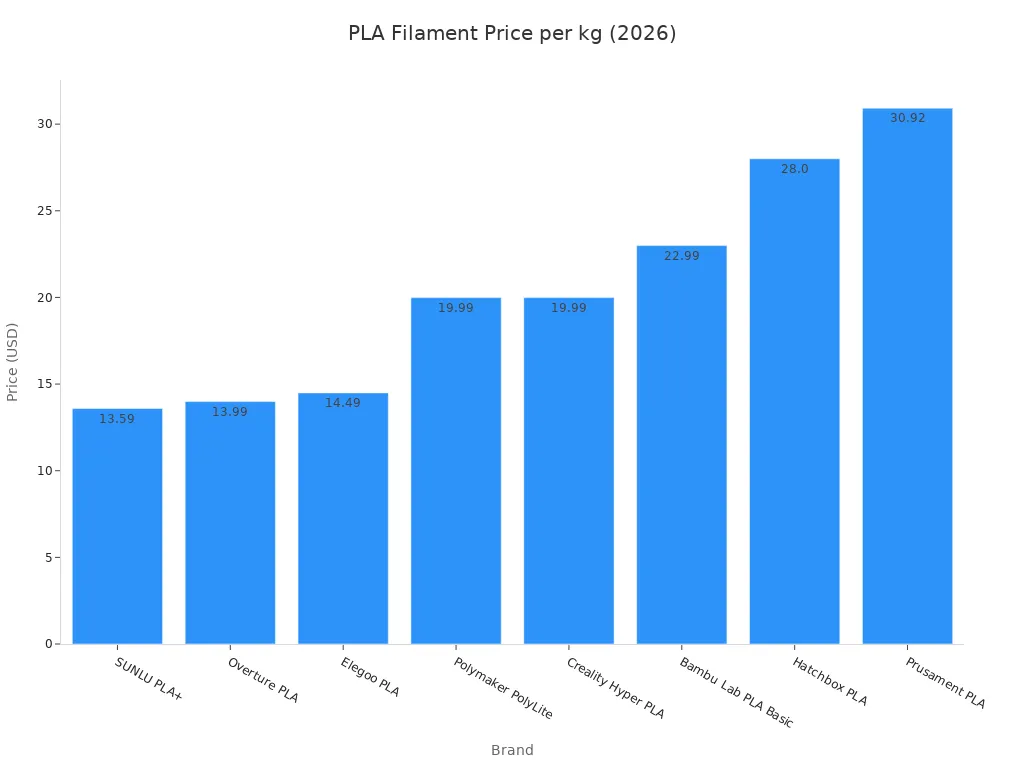
The median price for a quality PLA spool lands at $19.99 per kilogram. You can see the segmentation clearly. A budget tier exists around $14. A mid tier clusters near $20. A premium tier spans $28 to $31. Your choice depends on your project needs. For prototypes and decorative prints, budget PLA works perfectly. For functional parts or detailed models, you might prefer the consistency of a premium brand.
PETG and ABS cost slightly more than PLA. You will typically pay between $20 and $35 per kilogram for these materials. PETG offers better layer adhesion and higher temperature resistance than PLA. ABS provides impact resistance and durability for mechanical parts. Both materials require higher print temperatures. You also need proper ventilation when printing ABS. The extra cost reflects these enhanced properties and the tighter manufacturing tolerances required.
Specialty Materials: TPU, Nylon, and Composites
Specialty filaments push your creative boundaries, but they also push your budget higher. Flexible TPU ranges from $18 to $42 per kilogram. The price varies with shore hardness and flexibility ratings. Softer TPU formulations often cost more because they demand more precise extrusion control during manufacturing.
Nylon commands a premium price between $35 and $60 per kilogram. This engineering material offers exceptional strength and wear resistance. You might use it for gears, bushings, or functional prototypes. Nylon absorbs moisture from the air, so you must store it in a dry box. This extra handling requirement contributes to its higher cost.
Engineering composites blend base materials with reinforcing fibers. Carbon fiber reinforced nylon or PETG typically costs $30 to $60 or more per kilogram. These composites deliver stiffness and dimensional stability that pure plastics cannot match. Industrial-grade materials can exceed $60 per kilogram. Polycarbonate sits in this range at $40 to $60. At the extreme end, PEEK costs over $200 per kilogram. You would only choose PEEK for aerospace or medical applications where performance justifies the expense.
Your material selection directly impacts your project budget. A standard PLA spool might last you several weeks of casual printing. A specialty nylon spool could disappear in a single weekend of intensive prototyping. Plan your purchases around your actual printing needs rather than aspirational projects. This approach keeps your costs predictable and your workshop running smoothly.
Why Filament Costs Are Rising in 2026
You might wonder why your favorite spool now costs nearly 60% more than it did just a couple of years ago. The answer involves two powerful forces: supply chain disruptions and surging demand. Understanding these pressures helps you plan smarter purchases and avoid overpaying.
Supply Chain and Raw Material Pressures
The 59% price surge traces back to raw material shortages. Filament manufacturers rely on petroleum-based plastics like PLA, ABS, and nylon. When oil prices spike or chemical plants shut down, the cost of resin climbs immediately. Logistics disruptions add another layer of expense. Shipping containers remain scarce, freight rates stay high, and port delays stretch delivery times. These costs pass directly to you at checkout.
Manufacturers are fighting back with creative solutions. Companies like Creality now turn plastic scrap into new filament. This recycling approach reduces dependence on virgin resin and helps stabilize prices. However, recycled filament still represents a small fraction of total production. Until recycling scales up significantly, raw material costs will keep pushing prices upward.
You can protect yourself by watching market trends. When oil prices rise, expect filament prices to follow within weeks. Stock up during stable periods. Buy from brands that invest in recycling programs. These companies often maintain more consistent pricing than competitors reliant solely on virgin materials.
Demand Growth and Market Dynamics
Demand for 3d printer filament continues climbing across multiple sectors. Education leads this charge. Schools and universities now integrate 3D printing into STEM curricula. Each classroom printer consumes spools steadily throughout the academic year. Small businesses also contribute significantly. Custom manufacturers, dental labs, and prototyping shops rely on FDM printers for daily operations.
Several market dynamics sustain this growth. Industrial adoption in automotive, aerospace, and healthcare drives substantial filament consumption. These sectors use rapid prototyping to reduce costs and create complex geometries impossible with traditional methods. Batch processing and tooling applications increase filament usage further. Regulatory standards push manufacturers toward compliant materials, expanding product portfolios. Application diversification into bio-based and composite filaments opens new markets with higher margins.
Sustainable materials represent a growing opportunity. Environmental regulations drive demand for biodegradable options made from corn starch and agro-waste. Manufacturers developing green filaments meet circular economy principles while attracting eco-conscious buyers. This innovation expands choices but also introduces new production costs.
For you, this demand growth means prices likely stay elevated. Competition among brands helps moderate increases. Yet the fundamental pressure remains. Plan your purchases strategically. Buy during promotional periods. Consider subscription services that lock in prices. These tactics help you manage rising costs effectively.
Smart Ways to Save on 3D Printer Filament
Rising prices do not mean you must abandon your printing hobby. Smart purchasing strategies can cut your costs significantly. You can save 10-20% simply by changing how you buy. You can reduce waste by adjusting your print settings. This section shows you practical methods to stretch every dollar.
Bulk Buying and Subscription Discounts
Bulk purchasing offers the cheapest path to lower per-kilogram costs. Manufacturers reward larger orders with steep discounts. Consider Bambu Lab PLA basic filament as an example. A single 1kg roll costs $19.99. Order ten rolls, and the price drops to $10.99 per roll. That represents a 45% discount. The store consistently offers around 40% off for bulk orders. You can mix and match colors within these bulk orders. Buying ten rolls can actually cost less than buying eight rolls due to tiered pricing structures.
Before you commit to bulk buying, calculate the delivered price per kilogram. Shipping costs must factor into your comparison. A 2kg spool usually needs a 10-15% delivered-price saving to feel worthwhile. A 5kg spool often requires a 20-30% delivered-price saving. Larger spools demand careful storage and feed control. Unless you print frequently, a 5kg spool with only a 10% discount may not save money. It could require new hardware or lead to material waste.
Subscription services offer another avenue for savings. Many brands now provide monthly filament deliveries at reduced rates. These programs lock in prices against future increases. You also avoid shipping costs by bundling orders. Some services let you pause or skip months when your filament stock runs high.
Consider negotiating quarterly contracts through Amazon Business. This approach can secure 15-25% discounts on regular purchases. Small businesses and frequent hobbyists benefit most from this strategy. You commit to a volume, and the supplier rewards your loyalty.
Recycling and Alternative Sourcing
Recycling programs represent a growing trend in 2026. Closed-loop systems collect failed prints and industrial scraps to produce new filament. Companies filter, extrude, and sort this material to match virgin plastic quality. The United Nations Environment Programme reports over 400 million tonnes of annual plastic waste. This abundant source feeds the recycling pipeline.
Research shows HDPE can recycle into usable 3d printer filament up to seven times. Toxic particle emissions actually decrease with each recycling cycle. This finding lowers worker health risks while reducing plastic waste. Equipment costs continue to drop, making home recycling more accessible.
You can also explore take-back programs offered by filament manufacturers. These programs accept your used spools and failed prints. The company recycles them into new filament. You often receive store credit for participating. This approach builds brand loyalty while mitigating waste.
Budget and off-brand filaments provide another cost-saving option. These materials work well for non-critical parts and prototypes. Be aware that print quality may decrease by about 25% compared to premium brands. Surface finish and dimensional accuracy suffer slightly. For functional parts where appearance matters, stick with trusted brands.
Remember that a typical small print costs less than $1 in raw material. Focus on reducing waste rather than chasing the cheapest spool. Optimize your print settings by adjusting layer height, print speed, and infill density. Hollow out models or use lattice patterns for non-structural parts. These design strategies reduce filament usage without compromising strength. Choose cost-effective materials like PLA and ABS for general use. Save your premium filaments for projects that truly need their properties.
2026 Price Outlook and Trends
You now understand why prices climbed. The next question matters just as much: will costs keep rising, or will they level off? The answer shapes your purchasing strategy for the rest of the year. Market signals point toward continued pressure, but the picture contains surprising nuance.
Stabilization or Further Increases?
The $18 to $25 average for standard spools might not hold steady through late 2026. Several forces suggest prices could actually fall in specific segments. The table below summarizes the key indicators shaping your near-term outlook.
|
Key Indicator |
Value/Outcome |
Implication for 2026 |
|---|---|---|
|
Chinese production cost advantage |
30% lower than Western converters |
Structural cost gap prevents price recovery |
|
Global commodity PLA price ceiling |
Below USD 0.16 per gram |
Prices remain suppressed, no upward stabilization |
|
North American median filament price change (Q3 2024) |
-23% year-over-year |
Confirms ongoing deflationary trend |
|
Gross margins for small/mid-sized converters |
Compressed from 35–40% to 18–22% |
Permanent margin erosion forces market exit or specialization |
|
Market structure |
Structural oversupply (not cyclical) |
No near-term price rebound expected in 2026 |
These numbers tell a compelling story. Chinese manufacturers produce filament at costs 30% lower than Western converters. This advantage keeps downward pressure on global prices. Commodity PLA now trades below $0.16 per gram worldwide. That ceiling prevents any significant upward price movement.
You might find the North American data surprising. Median filament prices fell 23% year-over-year in Q3 2024. This decline confirms a deflationary trend that continues into 2026. Small and mid-sized converters feel the squeeze most acutely. Their gross margins dropped from 35–40% down to 18–22%. Many face a stark choice: exit the market or specialize in premium products.
The market structure itself points toward continued softness. Analysts describe the current situation as structural oversupply rather than a cyclical dip. Production capacity exceeds demand across most material categories. This imbalance means you should not expect sudden price rebounds in 2026. Your filament dollars may stretch further than current retail prices suggest.
Innovations in Low-Cost Materials
Manufacturers respond to margin pressure with creative material solutions. Recycled and blended filaments now offer lower costs without sacrificing quality. These innovations make 3D printing more accessible for hobbyists and professionals alike.
Several promising materials emerged from this push toward affordability:
-
rPLA (ReFill): Contains 50% recycled post-industrial PLA by weight. This blend lowers material cost while maintaining easy printing characteristics.
-
Bio-Filler PLA (Algae PLA, Hemp PLA): Combines 90% PLA with 10% reclaimed organic filler. The polymer portion contains 50% recycled PLA, reducing virgin polymer demand.
-
rPETg: Uses 100% post-industrial recycled PETg. This material serves as a drop-in replacement for virgin PETg, cutting raw material expenses.
-
Carbon Fibre–PETg: Blends 85% recycled PETg with 15% recycled carbon-fibre powder. This composite delivers high stiffness at lower cost than virgin CF alternatives.
BigRep launched rPLA and rPETG filaments in November 2025. These products use 100% post-industrial residual waste. The company collects, shreds, remixes, and homogenizes the material to ensure consistent quality. Printability and functional performance match virgin materials exactly. This launch supports cost reduction by replacing expensive virgin polymers with reclaimed waste. Large-format additive manufacturing becomes more economical as a result.
These recycled options change your purchasing calculus. You no longer must choose between budget and quality. The new generation of eco-friendly filaments delivers both. Your 3d printer filament budget can stretch further when you incorporate these materials into your regular rotation.
The trend toward sustainable materials will likely accelerate. Environmental regulations push manufacturers toward greener production methods. Consumer demand for eco-conscious products grows each year. These forces combine to expand the availability of affordable recycled filament. Your choices today help shape the market of tomorrow.
You now see the price landscape. PLA costs $15 to $30 per kilogram. PETG and ABS run $20 to $35. TPU falls between $18 and $42. Nylon reaches $35 to $60. Prices have risen, but affordable options remain.
Strategic purchasing delivers the biggest savings. Printing organizers, phone stands, toys, and tools replaces costly store-bought items. Bulk buying and recycling offer additional savings. Focus on reducing waste rather than chasing the cheapest spool.
2026 marks a year of adjustment. With the right knowledge, you can enjoy your hobby without breaking the bank. Your 3d printer filament budget can stretch further through smart choices.
Share your own money-saving tips or favorite budget filament brands in the comments. Help build a community resource for navigating 2026 costs.
Why Choose EPELAY 3D Printing Filament
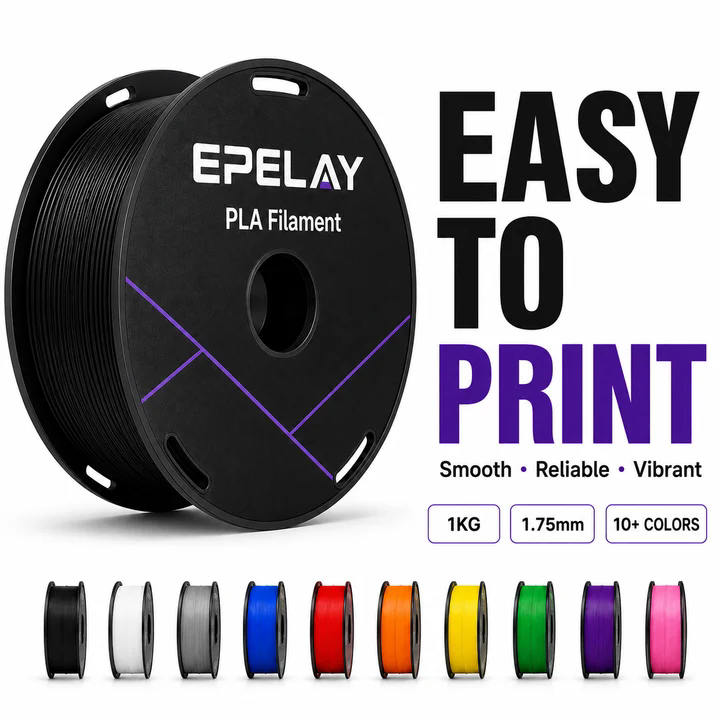
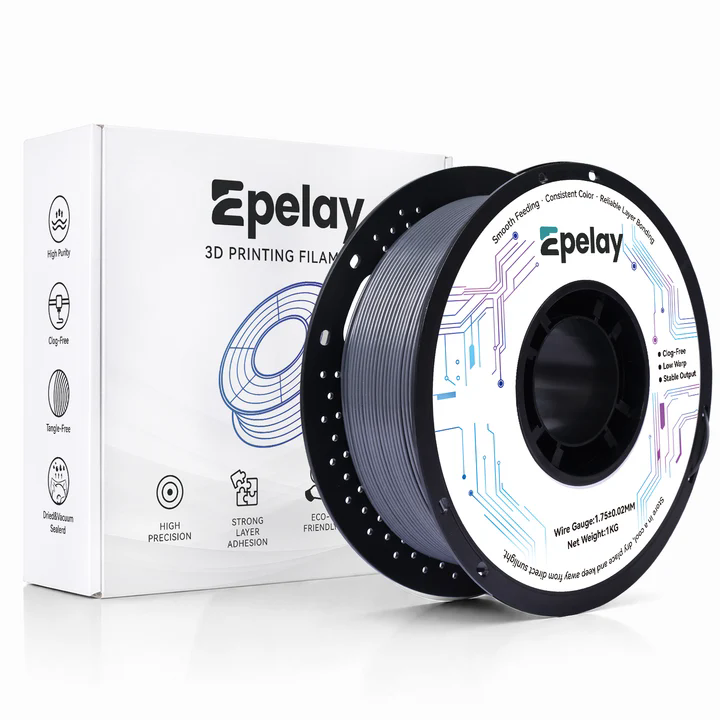
EPELAY stands out as a trusted choice for 3D printing enthusiasts, beginners, and professional creators seeking reliable, high-quality filament at exceptional value. We focus on consistent performance and user-friendly design to elevate every 3D printing project, from decorative art pieces to functional industrial parts. All our filaments feature a strict 1.75mm±0.02mm diameter tolerance and standardized 1kg spools, ensuring smooth feeding, zero clogging, minimal warping, and stable layer adhesion compatible with most FDM 3D printers.
We offer a diverse product lineup covering versatile PLA+, durable heat-resistant PETG, glossy silk PLA+, gradient and dual-color specialty filaments, and industrial-grade engineering materials. This comprehensive range meets all creative and functional printing needs for hobbyists, schools, print farms, and studios. Beyond premium quality, we deliver unbeatable customer value with our exclusive ongoing offer: mix any three in-stock items to get 40% off automatically at checkout with no coupon code required. Committed to bringing every creative idea to life, EPELAY combines reliable manufacturing quality, rich color options, and cost-effective pricing to make high-standard 3D printing accessible to all creators.
FAQ
How much should I budget for filament in 2026?
You should plan for $18 to $25 per standard 1kg spool. Budget PLA brands start near $14. Premium options reach $31. Your total monthly cost depends on print volume. A casual hobbyist might spend $30 to $60 monthly. Heavy users could exceed $150.
Will filament prices drop later this year?
Market signals suggest prices may soften. Chinese production costs run 30% lower than Western converters. Commodity PLA trades below $0.16 per gram. Structural oversupply exists across most material categories. Analysts see no near-term price rebound. You might find better deals in late 2026.
Does buying in bulk actually save money?
Yes, bulk purchases save 10-20% compared to single spools. Bambu Lab offers ten rolls for $10.99 each versus $19.99 for one roll. Calculate delivered price per kilogram before ordering. Factor shipping costs into your comparison. Larger spools require proper storage to prevent moisture damage.
Are recycled filaments worth trying?
Recycled options now match virgin material quality. BigRep launched rPLA and rPETG using 100% post-industrial waste. These filaments print identically to standard materials. They cost less and reduce environmental impact. You can use them for most projects without compromising quality.
What is the cheapest way to start printing?
Choose standard PLA from budget brands like SUNLU or JAYO. These cost $13.59 to $15 per kilogram. Focus on reducing waste through proper print settings. A typical small print uses less than $1 of material. Optimize infill density and layer height to stretch each spool further.


